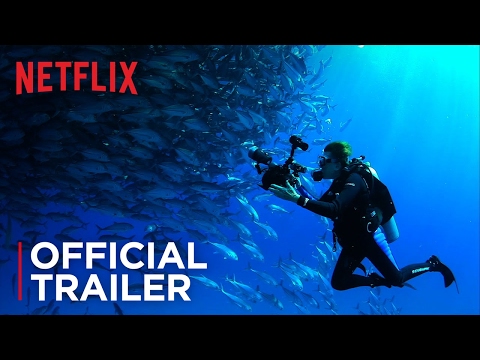
An ocean series organised around different habitats
Blue Planet II explores ocean life through a series of different environments, from tropical waters to the frozen poles. Its seven-episode structure gives reefs, deep water, open ocean and coastlines their own space, rather than making one animal or expedition carry the whole story. The series was released in 2017.
The habitat-by-habitat approach matters because an ocean is not a single kind of living space. The BBC episode descriptions move from the darkness and pressure of the deep sea to shallow coral reefs, the exposed open ocean and the boundary between land and water. Each setting presents animals with different opportunities and constraints.
Filming where sunlight cannot reach
The Deep brings that challenge into particular focus. A BBC Earth production retrospective describes producer Orla Doherty spending hundreds of hours in a submersible to record life in deep water. With no natural light available, obtaining an image became a technical problem as well as an expedition into an unfamiliar habitat.
The team developed two cameras that could operate together: one for wide views and another for close-ups. Highly sensitive sensors allowed the filmmakers to use less light, reducing the risk that their equipment would disturb the animals they were trying to record. The work also made it possible to capture bioluminescence, linking the appearance of the final images to practical decisions about the camera system.
The practical risks behind the expedition
The production account includes a difficult Antarctic dive in which cold water affected a seal on a submersible and water began to enter. The crew brought the problem under control before continuing the expedition. This is a reported experience from making the programme; it helps explain the demands on the team without assuming that every production incident appears in the finished episode.
Camera technology continued to develop during the four years of filming. In the BBC account, Doherty describes being able to do things near the end of the production that were not possible at its beginning. The series therefore records a period of technical experimentation alongside the behaviour of the animals themselves.
From individual animals to the future of the ocean
The BBC guide describes Green Seas through the kelp forests off southern Africa and the animals living among them. Coasts concerns the changing boundary between sea and land, while Our Blue Planet turns to the ways the oceans are changing. Together these subjects widen the series from particular animal encounters to the environments that sustain them.
The production retrospective places plastic pollution, climate change and conservation within that wider account. For a viewer choosing an ocean documentary, this makes Blue Planet II a broad introduction to habitats and wildlife, with filmmaking technology and human pressures forming part of the background. Its range differs from the narrower focus of a single-species story or one environmental investigation.